The abolitionist movement became strong in the 1830s and took on an almost militant approach, calling for an immediate end to slavery, which they considered a moral sin as well as a contradiction to the values in the Declaration of Independence. Not only did they want the immediate emancipation of slaves, but they also wanted them to be incorporated into American society as citizens with equal rights. The new abolitionists worked by distributing pamphlets and journals to express their opinions as well as holding meetings and speaking out in public against the atrocities of slavery. In 1831 one of the longest running and most recognized antislavery journals was published. The journal was entitled "The Liberator" and was written by William Lloyd Garrison, an editor and writer for a Massachusetts newspaper. Garrison sparked outrage and controversy, especially in the south, for his outspoken radical stance against slavery. Garrison insisted that "Wherever there is a human being, I see God-given rights inherent in that being, whatever may be the sex or complexion."

William Lloyd Garrison's Antislavery Journal
"The Liberator" published in 1831

In 1833 the American Anti-Slavery Society was formed by Garrison and close associates of his Lewis and Arthur Tappan, who were prominent New York business men. The Anti-Slavery Society organized meetings, petitions, and publications to be distributed mainly throughout the North in hopes of gaining awareness and support for their cause. They encouraged the emancipation of slavery through "moral suasion" by appealing to peoples moral concious and using non-violent tactics to accomplish their goals. Some of the groups most well known members included Frederick Douglass, a freed slave, author and public speaker against slavery; Theodore Weld, an outspoken minister who recruited masses to the antislavery movement; and the Grimke sisters, who later went on to be leaders in the early feminist movement. The organization met with great opposition, particularly in the South, and meetings were often disrupted by angry mobs, printing presses used to create antislavery material were destroyed and some outspoken slavery opponents were even killed in the violence. The Anti-Slavery Society also found controversy within its own organization as members became divided by the radical views of Garrison. Garrison not only proposed a seperation of the north from the south but also burned the constitution claiming it to be a "covenant with the devil".
Poster from 1837 encouraging people to
disrupt an antislavery meeting.

The 13th Amendment to the US Constitution
disrupt an antislavery meeting.
The typically non-violent stance of the abolitionist movement turned violent at the hands of the abolitionist John Brown. In 1856 Brown and his followers attacked a group of proslavery settelers. Shortly there after Brown traveled throughout Canada and the north to gain momentum for a war against slavery. The most famous event John Brown has come to be known for took place in 1859 which was an assault on the federal arsenal at Harpers Ferry in Virginia. Brown led a group of 21 men in a seize of Harper's Ferry. Brown and his men were captured or killed shortly after the seize and Brown was put on trial for treason and executed. John Brown became a martyr of the abolitionist movement, and particularly respected among Black leaders for sacraficing his own life in the name of social justice.
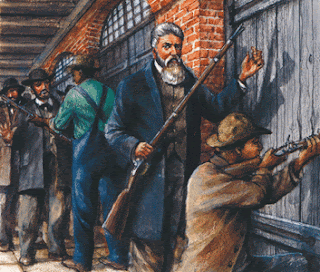
John Brown and his men at the raid on Harper's Ferry.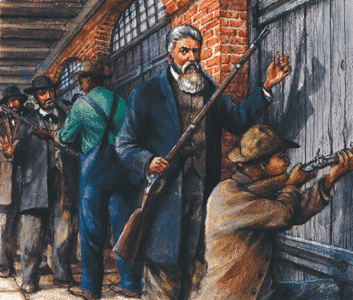
The abolitionist movement drew to an end in the 1860s with the election of President Abraham Lincoln. In 1863 Lincoln issued the Emancipation Proclamation which called for the end of slavery within the United States and declared those who owned slaves to be in "rebellion against the United States". This proclamation was not able to end slavery on its own and was later supported with the ratification of the 13th Amendment in 1865. The Amendment stated that "Neither slavery nor involuntary servitude, except as a punishment for crime whereof the party shall have been duly convicted, shall exist within the United States, or any place subject to their jurisdiction"(ourdocuments.gov). The passage of the 13th Amendment was a major victory for the abolitionist movement and Garrison and his supporters declared mission complete for the American Anti-Slavery Society.

Sources:
1. Foner, Eric (2009). Give Me Liberty!, An American History. Volume I, Second Seagull Edition
2. PBS online. Africans In America. Part IV Abolitionism. Retrieved from: http://www.pbs.org/wgbh/aia/part4/4narr2.html
3. New York State Archives. Civil Rights Heading of the Liberator. Retrieved from: http://iarchives.nysed.gov/dmsBlue/viewImageData.jsp?id=1585
4. The Library of Congress (2010). Abolition: The African-American Mosaic. Retrieved from: http://www.loc.gov/exhibits/african/afam005.html
5. Our Documents. 13th Amendment to the U.S. Constitution: Abolition of Slavery (1865). Retrieved from: http://www.ourdocuments.gov/doc.php?flash=old&doc=40
3. New York State Archives. Civil Rights Heading of the Liberator. Retrieved from: http://iarchives.nysed.gov/dmsBlue/viewImageData.jsp?id=1585
4. The Library of Congress (2010). Abolition: The African-American Mosaic. Retrieved from: http://www.loc.gov/exhibits/african/afam005.html
5. Our Documents. 13th Amendment to the U.S. Constitution: Abolition of Slavery (1865). Retrieved from: http://www.ourdocuments.gov/doc.php?flash=old&doc=40
